What is a Bent-axis Motor and How Does it Work?
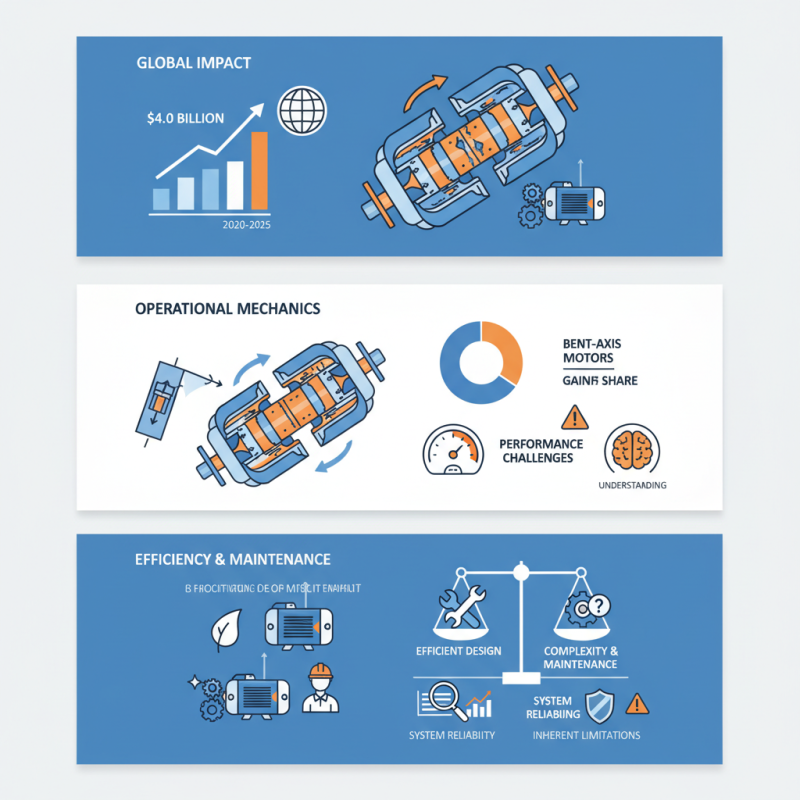
The Bent-axis Motor is a pivotal technology in modern hydraulic systems. Its design offers unique advantages over other motor types. Reports indicate that the global hydraulic motor market is projected to reach $6.5 billion by 2025. Within this market, Bent-axis Motors are gaining popularity due to their efficiency and compactness.
The function of a Bent-axis Motor relies on its unique geometry. Unlike standard motors, this design allows for a more direct transmission of power. As hydraulic pressures increase, some motors, including these, may face performance challenges. This is where understanding the mechanics becomes crucial. It is essential to evaluate how these motors handle varying operational conditions.
A growing trend highlights the shift towards more efficient motors like the Bent-axis Motor. However, their complexity can lead to maintenance issues. Proper training and data analysis are necessary to maximize performance. Balancing these factors can enhance overall system reliability, but it requires diligence and awareness of the inherent limitations.
What is a Bent-axis Motor?
A bent-axis motor is a unique design used in hydraulic systems. It converts hydraulic energy into mechanical energy efficiently. This motor has an angled drive shaft and pistons that operate at a bent angle. The design allows for compact installation in various machines.
The working principle revolves around hydraulic pressure. When hydraulic fluid enters, it pushes the pistons, causing rotational movement. This motion generates power for machinery, making it vital in applications like construction and agriculture. However, efficiency can vary. Sometimes, it may lead to energy losses due to internal friction.
Tips: When using bent-axis motors, ensure proper maintenance. Regular checks can prevent wear and tear. Understand the specifications to maximize performance. Also, consider the operating environment. Extreme conditions can impact durability.
In practice, bent-axis motors may require adjustment. Even with precise manufacturing, slight variations can affect efficiency. Users need to monitor performance continuously. Learning to recognize signs of wear is crucial for longer lifespan.
Key Components of Bent-axis Motors
Bent-axis motors are unique in design and function. They consist of several key components that work together to convert hydraulic energy into mechanical energy. The primary parts include an eccentric shaft, piston cylinder, and a rotor. The eccentric shaft plays a pivotal role. It creates an angled motion, which is essential for the motor's operation.
The piston cylinder houses the pistons. These pistons move in response to the hydraulic fluid's pressure. This movement generates torque, driving the rotor. The arrangement of these components must be precise. A small error can lead to inefficiencies. It might also affect the motor’s performance negatively.
Another critical component is the rotary joint. This joint allows hydraulic fluid to enter and exit. It must be robust to prevent leaks. However, leaks can still happen, leading to potential issues. Users must regularly check this component. Maintenance is crucial for longevity and efficiency. Overall, while the design is innovative, there’s always room for improvement.
Bent-axis Motor Performance Comparison
How Bent-axis Motors Operate Mechanically
Bent-axis motors are fascinating mechanical devices. Their unique design allows for efficient operation in various applications. Understanding how they work requires examining their mechanical principles.
The core of a bent-axis motor is its crankshaft. This shaft is not aligned straight; instead, it forms an angle with the motor body. This angle allows the input force to convert into rotary motion effectively. As the shaft rotates, it pushes a series of pistons housed within the motor. Each piston is connected to a cylinder, which contains hydraulic fluid. The movement of the pistons generates power.
One intriguing aspect of bent-axis motors is their adaptability. They can work under varying loads and adjust performance accordingly. However, they also have limitations. For instance, precision in alignment is crucial for optimal performance. If not perfectly adjusted, efficiency levels can drop significantly. This balance between performance and mechanical precision often challenges engineers. By continuing to innovate and explore, the full potential of bent-axis motors can be realized.
Applications of Bent-axis Motors in Industry
Bent-axis motors have found significant applications in various industries due to their unique design and efficient performance. These motors feature a shaft that is angled to the axis of the cylinder, which allows for a compact, lightweight design. According to a recent industry report, the global market for bent-axis motors is projected to reach $3.2 billion by 2026. This growth is largely driven by their increasing use in mobile machinery and renewable energy sectors.
In the construction industry, bent-axis motors are commonly used in hydraulic systems. They power excavators and bulldozers, offering high power-to-weight ratios. For instance, a typical bent-axis hydraulic pump can achieve efficiency levels over 90%. This hardware enables machinery to operate more effectively, especially in demanding environments. Additionally, in wind turbine applications, these motors help convert wind energy into mechanical power, contributing to more efficient energy solutions. However, it's crucial to acknowledge that their performance can decline with improper maintenance, leading to potential failures.
In the automotive sector, bent-axis motors are gaining traction for electric vehicle drive systems. Their light weight and high torque density make them suitable for battery-powered applications. A study highlighted that using bent-axis motors in EVs could enhance vehicle range by up to 15%. Yet, the costs of integration and the learning curves associated with newer technologies can deter some manufacturers. The industry must continuously adapt to overcome these challenges, ensuring that bent-axis motors remain a practical choice for the future.
Advantages and Disadvantages of Bent-axis Motors
Bent-axis motors are known for their unique design, which has implications for their performance. One key advantage is their compact size. This allows for installation in tight spaces where other motors might not fit. They are also highly efficient, converting hydraulic power into mechanical energy effectively. Their design offers a high power-to-weight ratio. This makes them ideal for mobile applications, such as machinery and vehicles.
However, there are drawbacks to consider. Bent-axis motors have a more complex assembly. This complexity can lead to higher maintenance needs. Less experienced technicians may find them challenging to repair. Additionally, these motors may experience more wear and tear over time. This can result in a shortened lifespan compared to simpler motor designs.
Another point to reflect on is their operating limits. Bent-axis motors may not perform as well under certain conditions, like extreme temperatures or pressures. Users need to familiarize themselves with these limits. In conclusion, while bent-axis motors offer notable benefits, they come with trade-offs that require careful consideration. Understanding both sides can help in making an informed decision.
What is a Bent-axis Motor and How Does it Work? - Advantages and Disadvantages of Bent-axis Motors
| Parameter | Description |
| Motor Type | Bent-axis motor |
| Operation Principle | Translates rotary motion into linear motion through a bent axis |
| Advantages | High power density, compact design, efficient at high speeds |
| Disadvantages | Higher costs, complexity in manufacturing, limited torque range |
| Typical Applications | Hydraulic machinery, aerospace, automotive |
| Installation Orientation | Can be mounted in various orientations depending on application needs |