China Best CNC Spring Machine Manufacturer?

China Best CNC Spring Machine Manufacturer? The answer depends on measurable performance, not a polished catalog or a low initial price. A reliable Cnc Spring Machine should produce consistent wire diameter, stable pitch, accurate cutting, and repeatable forming under continuous production. Operators notice the difference when a spring feeds smoothly, holds its shape, and leaves fewer rejected coils beside the inspection tray.

Industry data supports this shift toward controlled automation. Deloitte’s 2024 Smart Manufacturing Survey reports that 86% of manufacturers consider smart manufacturing important for competitiveness during the next three years. The International Federation of Robotics also recorded 541,302 industrial robot installations worldwide in 2023. These figures do not prove that every automated machine is suitable. They show why manufacturers increasingly examine software, sensors, maintenance access, and production data before purchasing equipment.

Shigeo Shingo, a respected manufacturing improvement expert, said, “The most dangerous kind of waste is the waste we do not recognize.” His warning applies directly to spring production. Hidden waste can appear as setup delays, unstable feeding, excessive scrap, or unavailable technical support. A strong Chinese supplier should therefore provide verifiable machine samples, clear accuracy tolerances, documented testing, and responsive after-sales service. Factory visits and trial production remain valuable. Online promises are not enough.

This guide compares practical selection factors for a Cnc Spring Machine manufacturer in China, including machine capability, customization, software control, operator training, export experience, and lifecycle cost. Some evaluations may remain imperfect, because real performance changes with wire material, spring geometry, and production volume. That uncertainty deserves attention before signing an order.
China Best CNC Spring Machine Manufacturer?

What Is a CNC Spring Machine?

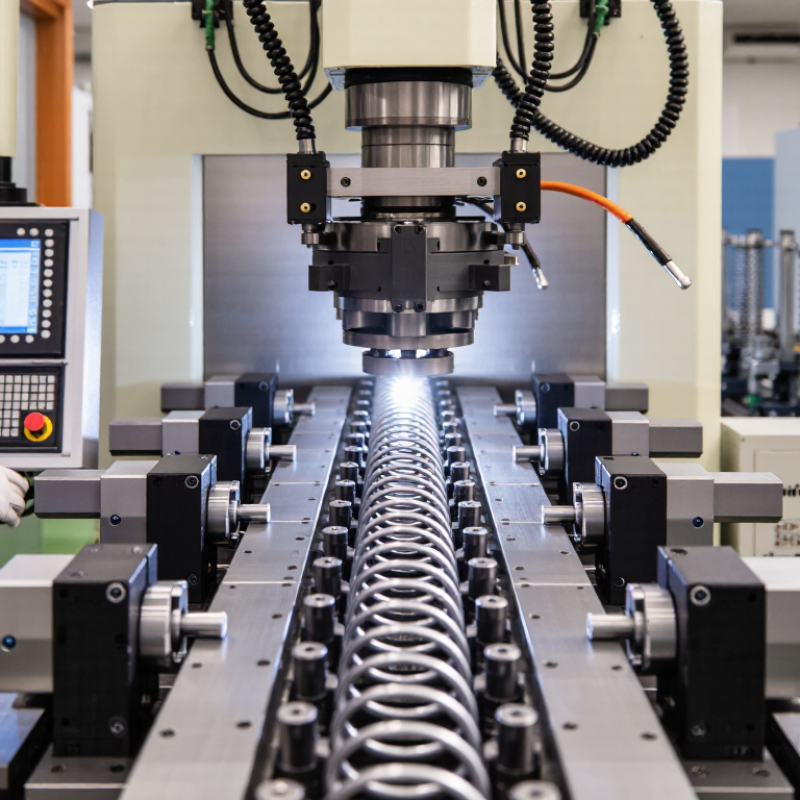
A CNC spring machine is a computer-controlled system for forming wire into accurate springs. It uses programmed movements to control feeding, bending, coiling, cutting, and sometimes end shaping. Unlike manual equipment, it coordinates several axes during one production cycle. This helps manufacturers produce compression, extension, torsion, and special-shaped springs with consistent dimensions.

The process begins with spring wire loaded into a feeding unit. Rollers move the wire toward forming tools, while sensors monitor position and speed. A digital controller stores settings such as wire diameter, coil diameter, pitch, and spring length. For example, a small compression spring may require precise pitch changes between each coil. Even a minor feeding error can affect its height and load performance.

Accuracy depends on more than software. Tool wear, wire hardness, lubrication, and machine calibration all influence results. Technicians usually inspect the first pieces with calipers, gauges, and load-testing equipment. Setup is rarely perfect.

A skilled operator may adjust forming coordinates by fractions of a millimeter after checking sample springs. This practical correction is important, because real wire does not always behave like a simulation. Temperature, surface condition, and material variation can also create unexpected results. Regular maintenance, documented inspections, and careful parameter control make CNC spring production more reliable.

How CNC Spring Machines Work

How CNC Spring Machines Work

A CNC spring machine converts digital instructions into controlled wire movement. The feeder pulls wire through straightening rollers. A rotating spindle controls pitch and feeding speed. Forming tools then bend the wire around a mandrel or against guide pins. Cutting tools separate each finished spring. Small timing errors can change the coil diameter, free length, or end shape.

Modern systems use servo motors, sensors, and programmable axes. These components coordinate feeding, rotation, bending, and cutting in milliseconds. Operators enter material diameter, coil size, pitch, and production length. The controller translates those values into synchronized movements. According to the International Federation of Robotics’ World Robotics 2024 report, 541,302 industrial robots were installed worldwide in 2023. This reflects a broader shift toward automated and repeatable production.

Material behavior still matters. Stainless steel may resist forming more than carbon spring wire. Heat, tool wear, and uneven lubrication can affect consistency. In practice, the first setup is rarely perfect. That assumption deserves review. Skilled technicians inspect samples with calipers, gauges, and force-testing equipment. A 2024 industry analysis from Grand View Research identified automation and precision manufacturing as major CNC market growth drivers. Yet speed alone does not prove quality. A reliable machine should maintain stable dimensions across long batches, record process data, and allow quick correction when wire memory changes.

Key Features of a Reliable Chinese Manufacturer

A reliable Chinese CNC spring machine manufacturer should prove performance before discussing price. The International Federation of Robotics reported 541,302 industrial robot installations worldwide in 2023. China accounted for 276,288 units, or 51% of the total. This scale supports strong automation expertise, but capacity alone is not enough. Ask for production records, machine acceptance tests, and sample springs made with your actual wire.

Precision begins with measurable control. A dependable supplier should verify wire diameter, coil diameter, pitch, free length, and spring force. Digital inspection records should link each result to a machine and production batch. The ISO Survey 2022 recorded 1,265,216 ISO 9001 certificates worldwide. Certification helps, but it cannot replace factory experience. I would inspect calibration labels, tool wear records, and operator training logs.

Service quality often decides the real cost. Reliable manufacturers provide clear drawings, electrical diagrams, spare-part lists, and remote troubleshooting procedures. They should also explain cycle-time limits and material compatibility without hiding weaknesses. No factory is perfect. A supplier that admits setup errors is often more credible than one promising zero defects. Before purchase, request a video trial, a written acceptance standard, and several sample batches under changing speeds. That evidence is more useful than polished showroom language.

China Best CNC Spring Machine Manufacturer? - Key Features of a Reliable Chinese Manufacturer

Evaluation Dimension Practical Benchmark Why It Matters Recommended Verification
Quality Management A documented quality management system aligned with ISO 9001 requirements Provides controlled procedures for purchasing, production, inspection, corrective action, and traceability. Request a current certificate, certification scope, issuing body, and certificate validity.
Wire Diameter Capability Typical CNC spring-forming equipment is configured for specific wire ranges, commonly from approximately 0.2 mm to 12 mm depending on machine class. The usable range determines whether the machine can produce the required spring sizes and materials. Match the exact wire diameter, tensile strength, material grade, and spring drawings to the proposed model.
Machine Axes and Tooling Multi-axis CNC control, commonly using 6 to 12 programmable axes for complex spring and wire-forming operations. More controlled axes can reduce manual adjustments and support complex geometries, but only when properly programmed. Review the axis list, servo configuration, tooling layout, and a sample production program.
Dimensional Repeatability A reliable supplier should state repeatability and test conditions; values around ±0.02 mm to ±0.05 mm may be achievable for suitable parts and processes. Repeatability affects batch consistency, assembly fit, and scrap rates. Request inspection records from an actual sample, including measurement equipment, tolerance, and environmental conditions.
Control System Industrial CNC control with program storage, parameter backup, alarm history, recipe management, and operator access control. Stable controls shorten changeover time and help protect production settings. Confirm interface language, data backup method, remote-support capability, and spare-control availability.
Material Compatibility The machine should be selected for the required materials, such as carbon spring steel, stainless steel, music wire, or copper alloys. Different materials have different hardness, springback, surface-finish, and tooling requirements. Run a trial using the customer’s actual wire material and verify dimensions after forming and heat treatment where applicable.
Production Efficiency Evaluate cycle time, setup time, automatic feeding, cutting method, and the number of operations completed in one setup. A shorter cycle is valuable only if dimensional stability and uptime are maintained. Compare a documented sample cycle using the same spring geometry, wire size, and quality requirements.
Electrical and Safety Compliance Electrical design should reflect the destination market’s requirements, including applicable machinery safety, electrical, and electromagnetic-compatibility rules. Compliance reduces installation, workplace-safety, and import risks. Confirm the voltage, frequency, protective devices, risk assessment, wiring documentation, and required conformity documents.
Inspection and Testing Pre-shipment inspection should cover machine operation, trial parts, dimensions, safety functions, accessories, and documentation. A defined acceptance process makes performance measurable before shipment. Use an agreed factory acceptance test with drawings, tolerances, sampling rules, and signed inspection records.
After-Sales Support Support should include installation guidance, operator training, troubleshooting procedures, software backup, and spare-parts planning. Effective support reduces downtime and improves the customer’s ability to maintain the machine locally. Obtain response-time commitments, service channels, training scope, warranty terms, and a recommended spare-parts list.
Total Cost of Ownership Assess purchase price together with tooling, freight, installation, energy use, maintenance, consumables, software, and downtime risk. The lowest initial quotation may not provide the lowest cost per acceptable spring. Compare a five-year cost model based on production volume, maintenance intervals, labor, and expected machine utilization.

Note: Technical ranges are general industry reference values. Actual capability depends on the machine configuration, wire material, tooling, spring geometry, tolerance, and production conditions.

Manufacturing Standards and Quality Control

China Best CNC Spring Machine Manufacturer?

Manufacturing Standards and Quality Control

Choosing a CNC spring machine manufacturer requires more than checking production speed. Reliable factories follow documented manufacturing standards at every stage. Engineers should verify wire diameter, tensile strength, and material certificates before production begins. Machines need calibrated feeders, forming tools, and cutting systems. Small calibration errors can create large differences in spring force. I have seen a minor wire deviation affect an entire batch. That lesson remains important.

Quality control should continue during forming, not only after packaging. Operators can inspect coil diameter, pitch, free length, and surface condition at scheduled intervals. Digital measuring tools improve accuracy, but trained workers still matter. Inspection records should identify machine settings, raw materials, and responsible personnel. Traceability builds confidence when adjustments become necessary. No factory is perfect. Honest reporting is better than hiding a process weakness.

Tips: Ask for sample inspection reports, calibration records, and material certificates. Confirm how rejected springs are isolated and reviewed. Request a small trial order before full production. Check whether quality standards match your application, not just the supplier’s brochure. A clear corrective-action process also matters. It shows whether the manufacturer learns from defects or repeats them. Quality control is not a single final inspection. It is a disciplined habit repeated throughout manufacturing.

How to Choose the Best CNC Spring Machine Manufacturer in China

Choosing the best CNC spring machine manufacturer in China requires more than comparing prices. In my experience, a factory audit reveals details that online catalogs often hide. Check machining areas, assembly procedures, and quality inspection records. A polished website proves little. Ask for a live video demonstration using your wire diameter, spring length, and production speed.

Request sample springs made from your actual material. Measure coil diameter, pitch, end shape, and repeatability across several pieces. The manufacturer should explain tooling choices, machine axes, software controls, and acceptable tolerances clearly.

Experienced engineers can identify whether your design needs a standard configuration or a customized solution. Their answers should be practical, not purely promotional.

Reliability also depends on service after delivery. Confirm spare-part availability, operator training, installation support, and response times. Ask for documented testing before shipment, including trial-run photographs and inspection data. Speak with recent customers when possible, but treat every reference carefully. No supplier is flawless. I would still question vague promises about lifetime accuracy or unlimited support. A small communication gap can become an expensive production delay. Clear drawings, written specifications, and agreed acceptance standards reduce that risk. Evaluate the factory’s consistency, technical honesty, and willingness to discuss weaknesses before signing a purchase contract.