What are Rotating Machines and How Do They Work?
In the dynamic landscape of engineering, Rotating Machines stand out for their pivotal role. Dr. Emily Thompson, a renowned expert on rotating machinery, once stated, “The efficiency of rotating machines can dictate the success of an entire industry.” This truth echoes across various sectors, highlighting their significance.
Rotating Machines, such as motors and turbines, convert energy through rotational motion. These machines are everywhere — from the smallest gadgets to massive industrial systems. Their operation relies on precise engineering principles. However, not all designs meet expectations. Some machines suffer from inefficiencies and failures, often due to overlooked details.
Understanding Rotating Machines is crucial. While we’ve made great strides, the industry still faces challenges. There are improvements to be made in design and maintenance. Future innovations depend on learning from past shortcomings. As industries evolve, the role of rotating machines will continue to be both essential and complex, compelling experts to rethink their approaches.
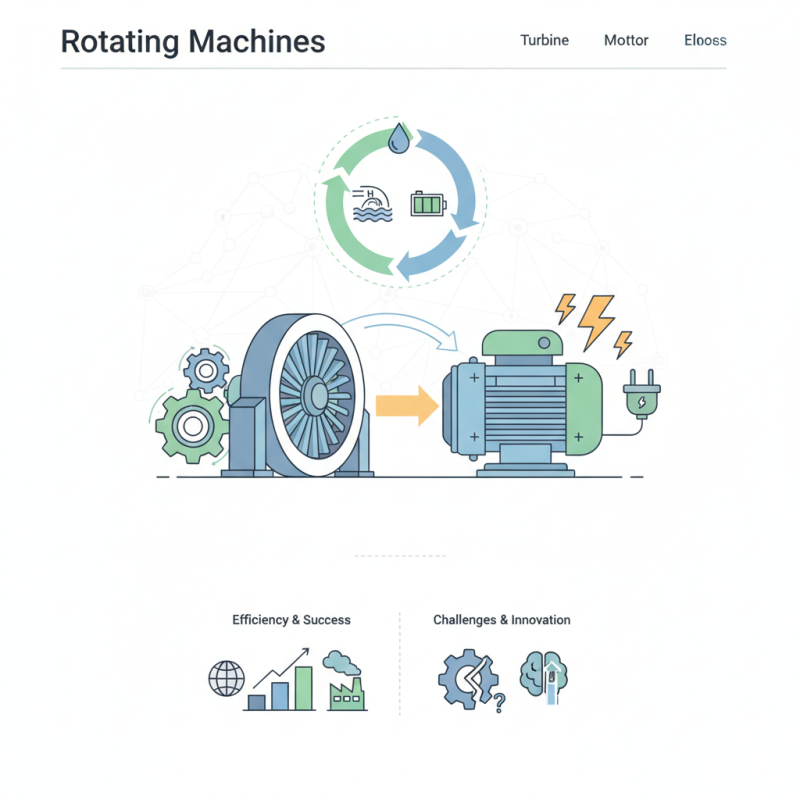
Overview of Rotating Machines: Definition and Types
Rotating machines are devices that convert mechanical energy into useful work. They play a crucial role in various industries. Every day, we encounter these machines, often without realizing their impact. Common types include motors and generators. These machines rotate around a central axis. This motion generates power or converts energy forms.
Electric motors are widely used for driving machinery. They often use magnetic fields to create motion. Generators, on the other hand, convert mechanical energy into electrical energy. They rely on rotational movement to function effectively. Pumps are another example, moving fluids by rotation. The design of these machines can vary significantly, affecting their efficiency and application.
Understanding rotating machines is complex. They require careful calibration and maintenance. An improperly maintained motor might lead to reduced performance. Generators can fail if not set up correctly. It's vital to monitor and evaluate their functioning regularly. Users often overlook small issues, which could escalate over time. Recognizing these aspects helps improve overall efficiency and longevity.
Overview of Rotating Machines
| Type of Rotating Machine | Definition | Common Applications | Operating Principle |
| DC Motor | An electric motor that runs on direct current. | Electric vehicles, fans, and conveyor belts. | Uses electromagnetic principles to convert electrical energy into mechanical energy. |
| AC Motor | An electric motor that runs on alternating current. | Industrial machines, home appliances, and compressors. | Converts electrical energy into mechanical energy using alternating current. |
| Generator | A device that converts mechanical energy into electrical energy. | Power plants, portable generators, and wind turbines. | Operates on electromagnetic induction principle to generate electricity. |
| Turbine | A rotary mechanical device that extracts energy from a fluid flow. | Power generation, propulsion systems, and water management. | Converts the energy of flowing or falling fluid into rotational energy. |
Key Components of Rotating Machines: Motors, Generators, and Pumps
Rotating machines are essential in various industries. Motors, generators, and pumps are the key components of these machines. Each component serves a distinct purpose yet works harmoniously together. Motors convert electrical energy into mechanical energy. They come in various sizes and types. Commonly, they power industrial equipment and household appliances. The choice of motor can greatly impact efficiency and performance.
Generators, on the other hand, do the opposite. They transform mechanical energy into electrical energy. They are crucial when providing power in remote locations or during outages. There are different types of generators. Some are portable while others are stationary. The design influences their efficiency and output. Using a generator must be done with care, as improper use can lead to failures or hazards.
Pumps play a vital role in fluid movement. They can be found in numerous applications, from water supply to industrial processes. Pumps can vary in design and functionality. A common mistake occurs when selecting a pump without considering the specific application. This can lead to reduced efficiency. Each component of a rotating machine holds importance. Their interplay defines overall performance. Understanding these components can lead to better choices and improved outcomes.
Principles of Operation: Electromagnetism and Mechanical Design
Rotating machines play a vital role in various industries. Their operation relies heavily on two fundamental principles: electromagnetism and mechanical design. Electromagnetism is crucial; it generates the magnetic fields needed to create motion. This principle allows electric currents to flow through wires, creating powerful magnetic fields.
Mechanical design complements this by ensuring the transfer of energy. Gears, rotors, and shafts work together harmoniously. They convert the electrical energy into motion. Each component must be precisely engineered. Even minor misalignments can lead to inefficiencies or failures.
Tips: Always keep an eye on the alignment of the components. Regular maintenance can greatly extend the lifespan of these machines. Sometimes, it's better to replace worn parts than to delay repairs.
Understanding these principles helps in optimizing machine performance. Breakdowns can often stem from inadequate design or poor electromagnetism application. Engineers need to reflect on their designs and make iterative improvements. Questioning existing designs may lead to innovative solutions.
Applications of Rotating Machines: From Industry to Renewable Energy
Rotating machines play a crucial role in various sectors. In industries, they drive processes that power production lines. Motors and generators convert electrical energy into mechanical energy and vice versa. From large turbines in power plants to compact motors in household appliances, their versatility is immense. Yet, challenges like maintenance and efficiency often arise and need addressing.
In renewable energy, rotating machines are vital for harnessing natural resources. Wind turbines capture kinetic energy from the wind and convert it into electricity. Hydro-electric systems use water flow to turn turbines, generating power sustainably. However, ensuring these systems operate optimally requires careful monitoring and adjustments. Mistakes in design or installation can lead to inefficiencies, impacting overall energy production.
The applications of rotating machines extend to transportation as well. Electric vehicles use sophisticated motors for better performance and energy efficiency. Yet, the technology is still evolving, with many engineers seeking to improve their designs. Not every solution is perfect, prompting ongoing research and development in this dynamic field.
Applications of Rotating Machines
This chart represents the various applications of rotating machines in different sectors, highlighting their importance in modern technology and renewable energy.
Performance Metrics: Efficiency, Power Output, and Maintenance Needs
Rotating machines are essential in various industries. Their performance metrics often focus on efficiency, power output, and maintenance needs. Efficiency indicates how well a machine converts energy. A high-efficiency rating means less energy is wasted. It's not always easy to achieve this. Many factors can affect efficiency, including design and operating conditions.
Power output tells us how much work a machine can perform in a given time. Not all machines perform consistently. Variations in load, speed, and temperature may change the output dramatically. Some units may run excellently for weeks but struggle afterward. Understanding these fluctuations is key to reliability.
Maintenance needs are equally critical. Regular checks can prevent unexpected downtime. Simple tasks, like lubrication, can make a notable difference. However, sometimes neglect occurs. Operators might miss warning signs, leading to failures. Over time, this can result in costly repairs or inefficiencies. Balancing performance with regular maintenance is a challenge many face.